
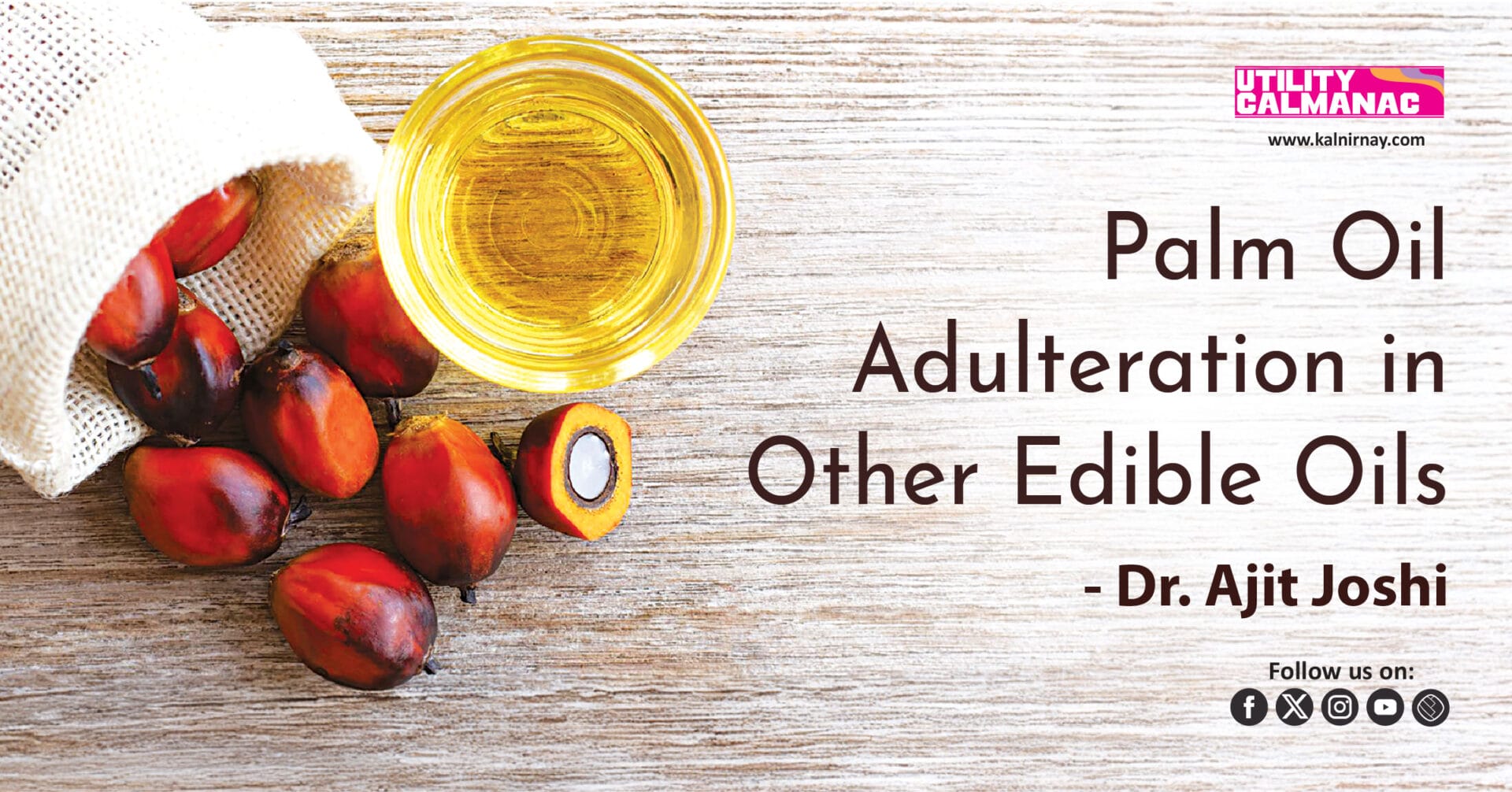
Palm Oil Adulteration in Other Edible Oils
A close, in-depth look at a serious issue
A wide variety of edible oils are produced in India, including groundnut, sunflower seed, soybean, safflower, mustard, sesame, and coconut oils, which are widely used across the country. However, since the domestic production of edible oils is insufficient for India’s large population, many oils (either in crude or refined form) need to be imported and distributed to consumers.
Among the oils imported, palm oil, palm kernel oil, soybean oil, and sunflower oil are the most prominent.
Besides these, there are a few oils derived from seeds, such as ghee extracted from mango kernels and kokum oil, which are used in food products. Oils extracted from seeds like neem and karanja are also widely available, though they are non-edible and are used to produce non-food items, such as lubricants. In India, castor oil, which is non-edible, is also produced in large quantities and exported globally.
In the Indian market, various edible oils are distributed in different packaging sizes, including bags and cans, and must be labeled in accordance with government regulations (FSSAI). The Indian food regulatory authority has permitted the blending of certain edible oils in specific proportions for sale. However, some producers do not adhere to these regulations, mixing cheaper oils in significant amounts with more expensive ones and selling them to consumers at higher prices. This practice of adulterating expensive oils with cheaper alternatives has also been observed.
According to statistics compiled by the government of India for the year 2022-23, the total domestic production of edible oils in India was approximately 12.4 million tons, while around 16.5 million tons of edible oils were imported. This indicates that the country’s production is significantly less than the vast demand of its population. As a result, the practice of mixing cheaper imported oils into more expensive domestic oils has increased.
Palm oil, being the cheapest edible oil (even when imported), is often used to adulterate other oils, especially the more expensive ones like groundnut, soybean, sunflower, and sesame oils. In government raids, it has been found that adulterated oils contain up to 70% palm oil! To mask the smell of palm oil and give it the flavor of more expensive oils, chemical fragrances are added. In adulterated groundnut or sesame oil, only 30% may be the genuine oil, while up to 70% could be palm oil, but the consumer ends up paying the full price for what they believe is branded, pure oil. Therefore, it is crucial for consumers to be cautious when purchasing edible oils, ensuring they choose oils that are properly labeled and come from reputed brands.
Excessive consumption of the expensive edible oils adulterated with large quantities of palm oil can negatively affect health, especially the heart. In India, there isn’t a significant demand for pure palm oil or its fraction, palmolein oil, therefore, they are not consumed directly in large quantities, in spite of large-scale imports. Instead, its main use is in the preparation of food products, and, to some extent, for adulteration with other edible oils.
The palm tree belongs to the coconut family and is commonly referred to as “Taal” or “Maad” in Marathi. The palm tree that produces oil is known as “Telmaad.” In regions with climates similar to Malaysia and Indonesia, palm trees are cultivated on a large scale, and oil extracted from their fruit is exported.
Various chemicals are also derived from these fruits and exported. Palm oil is the most widely produced edible oil globally, making it the cheapest. The combined oil yield from palm and palm kernel oil per hectare is higher than that of any other oilseed crop, currently yielding around four to five tons per hectare. In India, palm tree cultivation is an industry that is gradually gaining ground.
Two types of oils are obtained from these palm trees. The outer fleshy part of the fruit produces 30% to 70% palm oil, while the seed’s kernel (the inner part) yields 44% to 53% palm kernel oil. Since these oils differ in their fatty acid content, their properties also vary. Palm oil is similar to groundnut oil, while palm kernel oil is akin to coconut oil. Broadly speaking, palm oil is used as edible oil, while palm kernel oil is more expensive and therefore has more non-edible uses. When stored in tanks, a portion of palm oil solidifies and settles at the bottom, known as “palm stearin,” while the liquid portion on top is referred to as “palmolein.” Palm stearin contains higher amounts of palmitic acid (C16), a saturated fatty acid, while palmolein is richer in oleic acid (C18:1), an unsaturated fatty acid. Palmolein, derived from palm oil, can also be used for adulteration purposes.
From a health perspective, palm oil is rich in saturated fatty acids. The fatty acid composition of palm oil can be broken down as follows: palmitic acid (C16) 42% to 47%, stearic acid (C18) 4% to 6%, oleic acid (C18:1) 37% to 41%, and linoleic acid (C18:2) 9% to 11%. Palm stearin contains higher levels of stearic acid, while palmolein has higher amounts of oleic and linoleic acids.
Compared to palm oil, the major fatty acid composition of groundnut or peanut oil is as follows: palmitic acid 8.3%, stearic acid 3.1%, oleic acid 56%, and linoleic acid 26%. This breakdown of the composition and their comparison helps us understand that when palm oil is mixed with groundnut oil, the mixture’s saturated fat content increases significantly. Thus, consuming groundnut oil adulterated with palm oil increases the likelihood of health issues for consumers who buy the product expect to be consuming pure groundnut oil. Since sunflower and sesame oils have an even higher proportion of unsaturated fatty acids than groundnut oil, consuming adulterated versions of these oils can be even more harmful to health.
It is, however, not so easy for the average consumer to detect adulteration in edible oils available over the counter. However, samples of such oils can be tested using advanced technology, such as gas chromatography, which are performed in modern laboratories.
In June 2019, the Food Safety and Standards Authority of India (FSSAI) approved the use of a handheld device called the Raman 1 Spectrometer, which is battery-operated and portable. This device incorporates advanced technologies like micro-optics, cloud computing, mobile technology, artificial intelligence, and machine learning. It is capable of scanning the oil through its plastic packaging and instantly displays its analysis on the screen of the mobile device connected to it.
After successfully testing numerous oil samples using this device and other laboratory equipment, the FSSAI approved this small, handy tool for detecting adulteration in oils. This method does not entirely replace laboratory-based analysis. It does, however, help in instant detection of oil available at retail outlets, without sending samples for testing in laboratories.
To detect palm oil adulteration in groundnut oil at home, one can use a simple, chemical-free method. Place a bowl of oil in the refrigerator for about two to three hours. In case of palm oil adulteration, it will solidify and look like ghee. Pure groundnut oil, on the other hand, will remain liquid. Due to the high saturated fat content in palm oil, adulterated oil solidifies faster and more extensively.
To read more English blogs, please visit our blog section.
Dr. Ajit Joshi
The author has Ph. D. (Tech.) in Oil Technology and is a chemicals and vegetable oils consultant.