
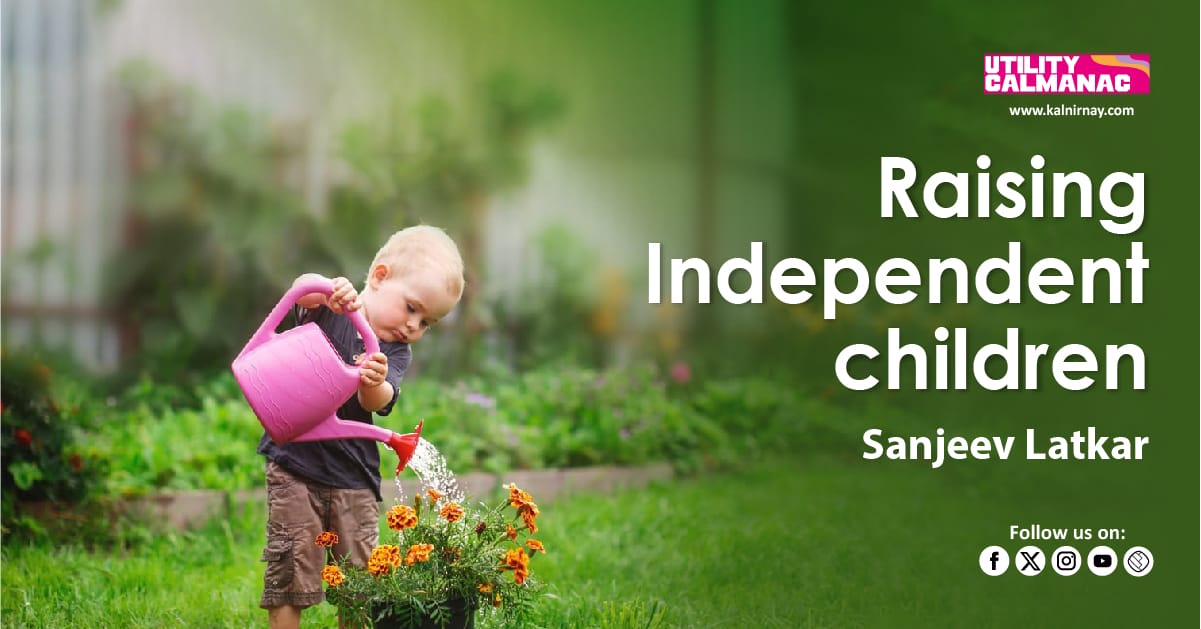
Raising Independent Children
Identifying the fine line between dependence and indepen-dence in growing children in today’s day and age.
Where humans are social creatures, the rest of the living world tends to be self-reliant. Think about the animals and birds around us: their young learn to fend for themselves as quickly as possible. The same is true for saplings and small plants. Self-reliance is a fundamental principle of life, an instinct embedded in nature. In this cycle of life, there is no time to wait for anyone, and prolonged dependence often means the end.
Humans are part of this same natural cycle. But, unlike other species, the journey to independence in humans is slow. A child’s brain, emotions, world, body, perception, education, mental health, skills, family environment, and social awareness take years to develop, as compared to this same process in other forms of life. During this time, however, it is also important to instill values that shape their personality.
Compared to other newborns, human children remain dependent for a much longer, often indefinite, period, and for good reason. Still, parents must ensure this phase doesn’t drag on unnecessarily. With thoughtful guidance, they can help shorten it.
It is a core responsibility of parents to nurture self-reliance in their children in a healthy, sustainable, and lasting way. Yet, often unknowingly, whether out of ignorance, misplaced affection, or overindulgence, parents may prolong a child’s dependence. While no human child will achieve independence as quickly as other creatures, the deliberate, conscious effort of parents can make a decisive difference.
Children cannot become self-reliant overnight. It is a process of trial and error, and every child has their own pace. Self-reliance should be treated as a value, not a competition. Helping children become self-reliant takes consistent effort, patience and hard work. Fight the urge to compare your children to others.
But why do some parents struggle so much with it? Often, it is because, unintentionally, they make their children dependent first, and only when problems arise, do they try to encourage independence. By then, the process requires more effort and yields slower results.
For example, a mother once told me how her two-year-old daughter tripped while playing at home. The mother immediately dropped what she was doing and ran over. But the child thought no one was around, quickly stood up on her own and went back to playing. This is a child’s natural instinct; even after a fall, they will often get up without help. But when we show excessive sympathy, and if this happens often, the child will begin to expect it every time. This can create dependency.
Parents are indeed a protective shield for their children, and it’s natural to want to help when they fall. But when that shield becomes overprotective, when we worry too much, intervene too quickly, or shield them from every small difficulty, we risk making them dependent in their everyday lives. Such children may struggle to make decisions for themselves, to express themselves clearly, or to cope with challenges.
The more we keep children away from experiences out of vague or unfounded fears, the more dependent they will remain.
When a child is old enough to understand, it becomes essential to teach them how to cross the road and step aside quickly if needed. Once they’ve learned, it’s even worth quietly observing them cross without their knowledge. But if you continue holding their hand every single time, you risk making them dependent. I know of a mother who held her child’s hand to cross the road until the child was in Class IX. The outcome of such over-protection is rarely pleasant.
Exploration is a natural instinct in children. Even if you explain the rules of a game, a child might still try to play it differently. This is their curiosity, imagination, and individuality at work, early signs of “out-of-the-box” thinking. It shows they are developing self-reliance not just in actions, but in thoughts. If their thinking is heading in the right direction, it’s important to encourage and praise it.
Parents often take pride when their children listen to them. But if your child listens to you every single time, never questions you, never thinks differently and never makes independent choices, that is not discipline. It is more a a sign that they have never stepped out from under your shadow. Such children are often reluctant to develop independent personalities, because they lack the confidence to stand on their own.
Self-reliance starts with small tasks like putting away shoes and making the bed, and grows into independent thinking, emotional maturity, decision-making, self-confidence, and, ultimately, a strong personality. The habits and experiences of childhood expand into adulthood. What begins as small acts of dependence can turn into lifelong hesitation. Many people grow up avoiding challenges because their confidence never had the chance to develop. The seeds of dependence, sown in childhood, can become the first and greatest enemy of self-confidence.
Is there a risk in making children self-reliant? Yes, there is. But good parenting means knowing how to reduce that risk without removing the opportunity. The idea is that you are “there,” but the child feels you are “not there.” Parenting, at its best, is about being present like an invisible force, watching over them without being seen. We are the unseen protectors of children. But if a child sees that protector constantly, they will grow dependent on the shield and stop relying on themselves.
Another key point is that every act of self-reliance in children should be praised. I once visited a home where a bright three-year-old girl brought me a glass of water. The care and focus with which she carried and handed it to me were admirable. I praised her, and she beamed. After that, she didn’t leave my side until I left, happy that someone had appreciated her effort. I liked her behaviour because she had stepped beyond her age’s usual boundaries and taken on an “adult” responsibility herself.
While encouraging self-reliance, don’t expect perfection. A child may put on shoes the wrong way, wear clothes unevenly, or keep books in a messy pile. That’s fine, the priority is their willingness to try. The desire for independence matters more than neatness at this stage. Children will reach a stage of accuracy and organization in their own time, according to their temperament.
Self-reliance should not feel like a burden or a chore. If parents can make it fun and enjoyable, the level of independence achieved will be much greater, and will stay for life.
To read more English blogs, please visit our blog section.
Sanjeev Latkar
The author is a life skills, parenting mentor, author, and speaker.